SSE Server-Sent Events
Introduction
Server-Sent Events (SSE) is a server push technology that allows servers to push data to clients in real-time. It is particularly useful in the following scenarios:
- Real-time data updates (e.g., stock prices, weather information)
- Social media feeds
- Real-time log display
- Progress notifications
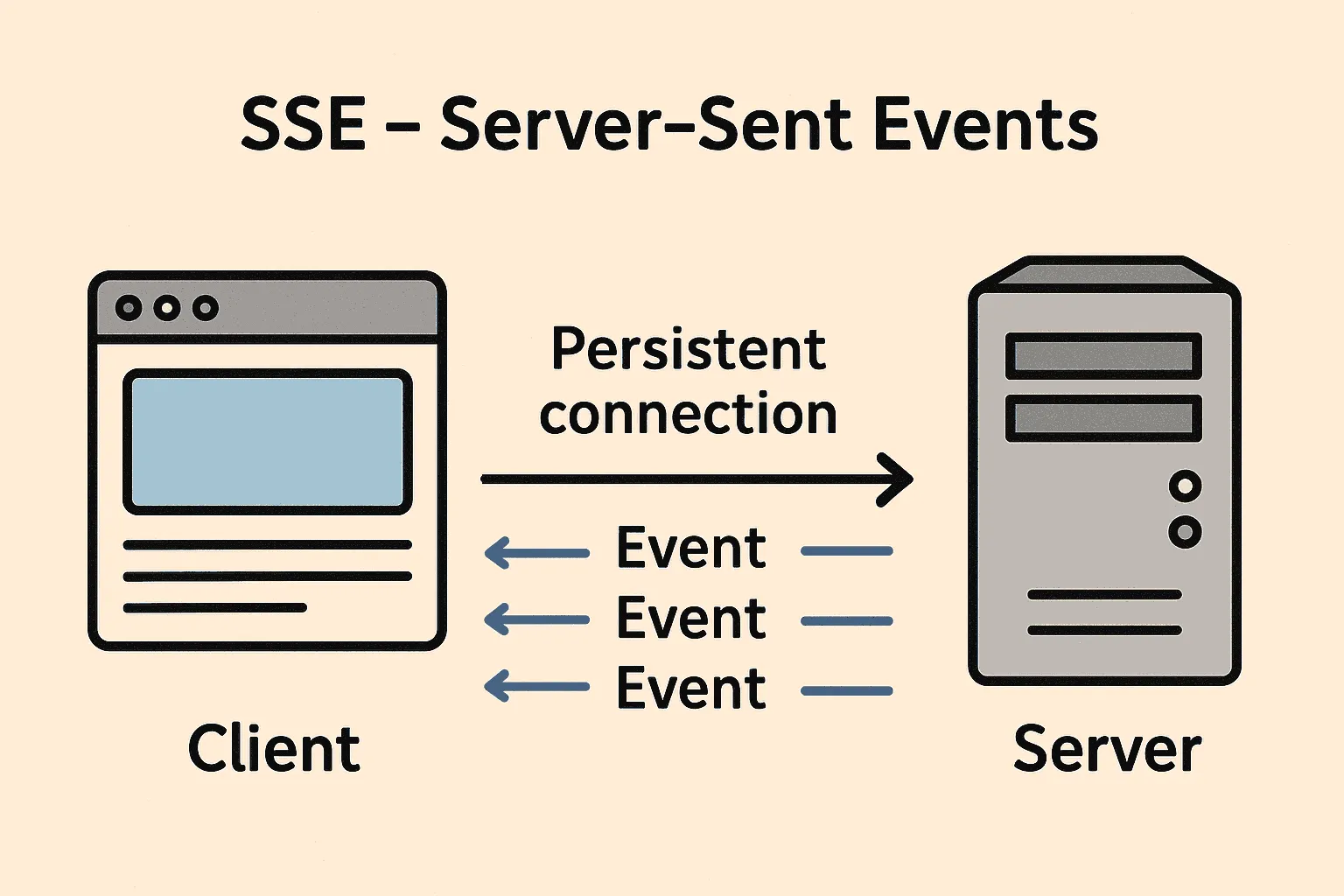
The Essence of SSE
SSE is essentially a one-way communication mechanism based on the HTTP protocol:
- It uses HTTP long connections to achieve a one-way data flow from the server to the client.
- The data format is plain text, and the encoding must be UTF-8.
- It is based on the standard HTTP protocol and does not require special protocol support.
Characteristics of SSE
- One-way communication: A one-way data flow from the server to the client.
- Automatic reconnection: Automatically reconnects by default after a disconnection.
- Easy to use: Uses standard HTTP, without the complex configuration of WebSockets.
- Supports custom events.
- Natively supports Cross-Origin Resource Sharing (CORS).
SSE Client API
Basic usage example:
const evtSource = new EventSource('/events');

// Listen for messages
evtSource.onmessage = function(event) {
    const data = JSON.parse(event.data);
    console.log(data);
};

// Listen for connection open
evtSource.onopen = function() {
    console.log('Connection established');
};

// Listen for errors
evtSource.onerror = function(err) {
    console.error('Error occurred:', err);
};

// Listen for custom events
evtSource.addEventListener('custom-event', function(e) {
    console.log('Custom event:', e.data);
});

// Close connection
// evtSource.close();
SSE Server Implementation
Data Format
The data sent by the server must follow a specific format:
- Each message starts with
data: - Each message ends with
\n\n - Supports multiple fields:
data,event,id,retry
The data Field
data: Message content\n\nMulti-line data:
data: First line\n
data: Second line\n\n
The id Field
Used for message identification; the Last-Event-ID header will be sent upon reconnection after a disconnection:
id: 1\n
data: Message content\n\n
The event Field
Used to specify the event type:
event: custom-event\n
data: Message content\n\n
The retry Field
Specifies the reconnection time (in milliseconds):
retry: 10000\n
data: Message content\n\n
Node Server Example
const express = require('express');
const app = express();

app.get('/events', (req, res) => {
    // Set headers required for SSE
    res.writeHead(200, {
        'Content-Type': 'text/event-stream',
        'Cache-Control': 'no-cache',
        'Connection': 'keep-alive'
    });

    // Send initial data
    res.write('data: Connection established\n\n');

    // Send data periodically
    const intervalId = setInterval(() => {
        const data = {
            time: new Date().toISOString(),
            value: Math.random()
        };

        res.write(`data: ${JSON.stringify(data)}\n\n`);
    }, 1000);

    // Listen for connection close
    req.on('close', () => {
        clearInterval(intervalId);
    });
});

app.listen(3000, () => {
    console.log('SSE server running on port 3000');
});
Notes
- Specific format requirements: Starts with
data:and ends with\n\n. - There is a limit to the number of concurrent SSE connections per browser.
- Some proxy servers may not support long connections.
- It is recommended to implement an error retry mechanism.
- Pay attention to server resource management when using it on a large scale.
Differences Between SSE and WebSocket
SSE
SSE is implemented based on the traditional HTTP protocol, using a long-polling mechanism. The client sends an HTTP request to the server, and the server keeps the connection open, periodically sending data to the client.
SSE is implemented through the EventSource object, and the client can receive data sent by the server by listening to the onmessage event.
WebSocket
WebSocket is implemented based on an independent TCP connection, using a custom protocol. A persistent, full-duplex communication connection can be established between the client and the server, allowing data to be sent and received in both directions.
The WebSocket protocol is frame-based, and communication can be achieved by sending different types of frames.
Conclusion
SSE is a simple yet powerful server push solution:
- Lighter and simpler to implement than WebSocket.
- One-way communication satisfies most push scenarios.
- Based on the HTTP protocol, offering good compatibility.
- Automatic reconnection mechanism improves reliability.
Applicable scenarios:
- Real-time data updates
- Message notifications
- Log streaming