Handwritten instanceof Implementation
In frontend interviews, instanceof is a frequently asked question. Interviewers often ask candidates to implement instanceof from scratch to test their understanding of JavaScript’s type system and prototype chain.
Type Checking
In JavaScript, data is divided into primitive types and reference types.
Primitive Types:
NumberStringBooleanundefinednullSymbolBigInt
Reference Types:
ObjectArrayFunctionDateRegExpMapSetPromise- …
In practical work, we often need to determine the type of a variable. For primitive types (except null) and Function, we can use typeof for checking. For reference types, we need to use instanceof.
// Primitive data types
let numberExample = 123;
let stringExample = "hello";
let booleanExample = true;
let nullExample = null;
let undefinedExample = undefined;
let symbolExample = Symbol("example");
let bigIntExample = BigInt(10);

// Reference types
let objectExample = {};
let arrayExample = [];
let functionExample = function () {};
let dateExample = new Date();
let regExpExample = /abc/;
let mapExample = new Map();
let setExample = new Set();
let promiseExample = new Promise(() => {});

// Scope of typeof
console.log(typeof numberExample); // number
console.log(typeof stringExample); // string
console.log(typeof booleanExample); // boolean
console.log(typeof undefinedExample); // undefined
console.log(typeof symbolExample); // symbol
console.log(typeof bigIntExample); // bigint
console.log(typeof functionExample); // function

// typeof cannot accurately check null and other reference types
console.log(typeof nullExample); // object. This is a historical legacy issue; null is actually a primitive data type.
console.log(typeof objectExample); // object
console.log(typeof arrayExample); // object
console.log(typeof dateExample); // object
console.log(typeof regExpExample); // object
console.log(typeof mapExample); // object
console.log(typeof setExample); // object
console.log(typeof promiseExample); // object

// instanceof checks the specific type of an object
console.log(objectExample instanceof Object); // true
console.log(arrayExample instanceof Array); // true
console.log(functionExample instanceof Function); // true
console.log(dateExample instanceof Date); // true
console.log(regExpExample instanceof RegExp); // true
console.log(mapExample instanceof Map); // true
console.log(setExample instanceof Set); // true
console.log(promiseExample instanceof Promise); // true
What is instanceof?
MDN Definition: The instanceof operator tests to see if the prototype property of a constructor appears anywhere in the prototype chain of an object. In other words, instanceof can be used to determine whether an object was created by a specific constructor.
function Car(make, model, year) {
  this.make = make;
  this.model = model;
  this.year = year;
}

const auto = new Car("Honda", "Accord", 1998);
console.log(auto instanceof Car); // true
In this example, auto is an instance of Car, so auto instanceof Car returns true.
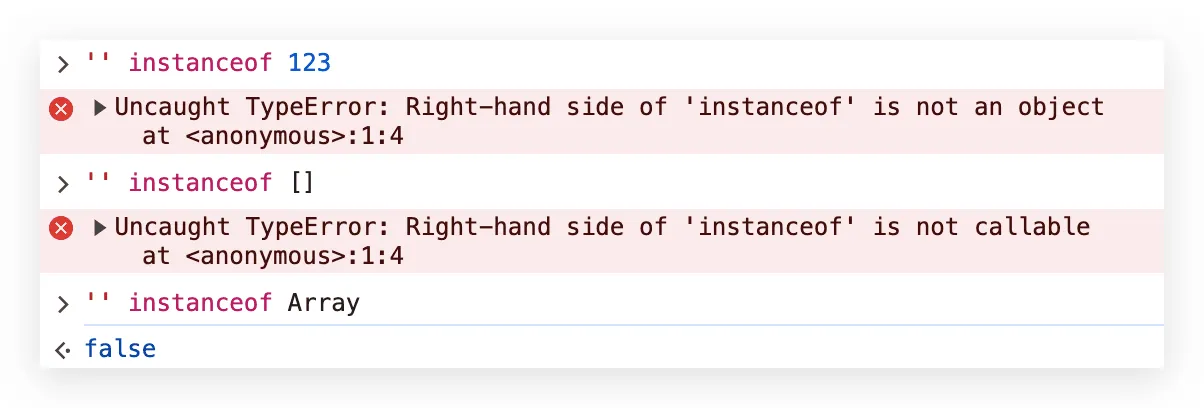
Note: The left side can be of any type, while the right side must be an instance of a function. A parameter error will throw an exception.
Principles of instanceof
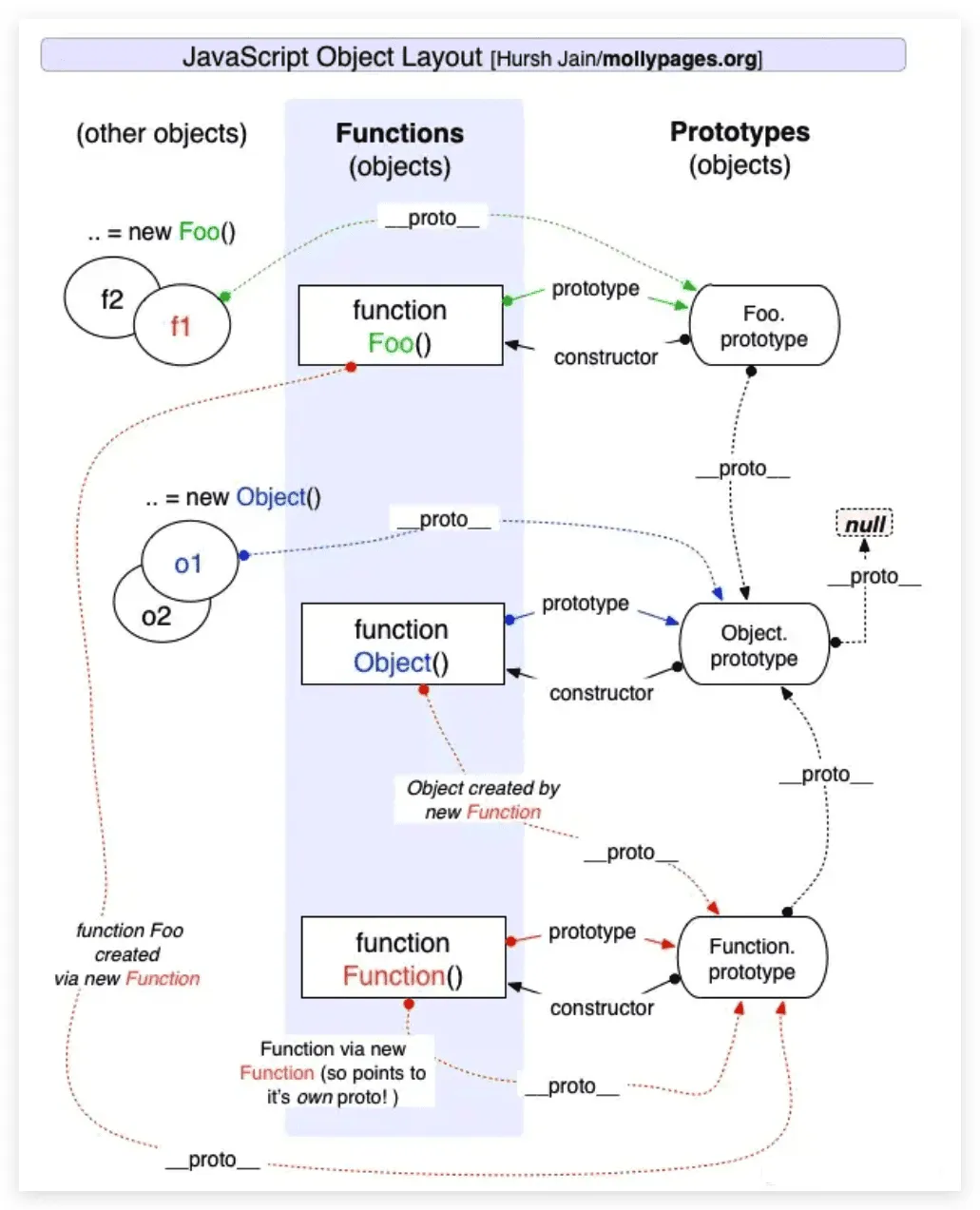
Every object has a __proto__ property. When an object is created, its __proto__ property points to the prototype property of its constructor. Furthermore, the prototype property of the constructor is itself an object, which also has its own __proto__ property. This chaining via __proto__ -> prototype forms a chain known as the prototype chain. The end of the prototype chain is Object, and the value of Object.prototype.__proto__ is null.
The constructor of every object can be found on the prototype chain, hence instanceof can determine if an object was created by a certain constructor through the prototype chain.
Implementing an instanceof
Handwritten instanceof
Implementing instanceof from scratch can help us gain a deeper understanding of JavaScript’s prototype chain. Below is a simple implementation of instanceof:
- Parameter validation
- Compare
obj.__proto === constructor.prototype
- If found, return
trueimmediately - When traversing reaches the end of the prototype chain
constructor.prototype === null, returnfalse
function myInstanceof(obj, constructor) {
  const BASIC_TYPE = [
    "[object Undefined]",
    "[object Null]",
    "[object Number]",
    "[object String]",
    "[object Boolean]",
    "[object Symbol]",
    "[object BigInt]",
  ];

  const objType = Object.prototype.toString.call(obj);
  const constructorType = Object.prototype.toString.call(constructor);

  if (BASIC_TYPE.includes(constructorType)) {
    throw TypeError("Right-hand side of 'instanceof' is not an object");
  }
  if (typeof constructor !== "function") {
    throw TypeError("Right-hand side of 'instanceof' is not callable");
  }
  if (BASIC_TYPE.includes(objType)) {
    return false;
  }

  let objProto = Reflect.getPrototypeOf(obj);
  while (objProto !== null) {
    if (Object.is(objProto, constructor.prototype)) {
      return true;
    }
    objProto = Reflect.getPrototypeOf(obj);
  }
  return false;
}
When the passed parameter is an object, if the operation succeeds,
Reflect.getPrototypeOf(target)returns the prototype of the object; if it fails (e.g., the target is not an object), it returnsfalse.
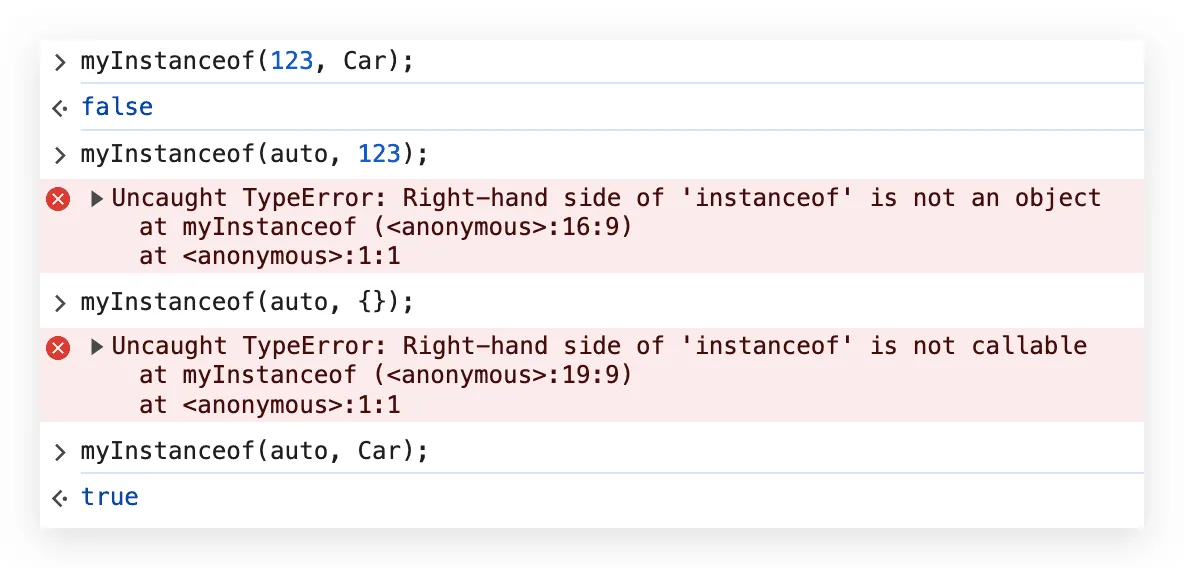
Test Results
Conclusion
This article introduced methods for type checking in JavaScript, along with the concepts, usage, and implementation of instanceof.